Developing Academic Job Materials
Mid Theory Collective
Aug. 7, 2026
Just before the new academic year/hiring season began, I teamed up with Mid Theory Collective to demystify the academic job application process and offer new(er) job seekers advise on adapting their job materials for teaching-intensive positions. The state of academia continues to worsen: teaching is unbundled from research and course loads and enrollment caps are getting higher. Yet, the demands on junior teacher-scholars to publish and perish in academia remain the same—we’re compelled to perform uncompensated labor in the hope that we can one day catch the eye of a hiring committee and secure one of those increasingly rare tenure-track and research-intensive jobs.
The career readiness training many graduate students receive is still woefully inadequate to address these conditions. I’ve taken some of my most formative experiences as a teaching-track scholar—on both sides of the hiring committee—to present my best advice to new applicants. None of this is definitive; there are far too many exceptions to the rules that none of us can know or predict, from a hiring school’s institutional identity to the vibes of the search committee. But I hope it helps all the same.
In the interest of streamlining this presentation, I’ve removed my close readings of job listings and the sample documents I provided for MTC. For access to those documents, contact the MTC editorial board.
AGENDA/OVERVIEW
1. Types of teaching-focused jobs in higher education
2. How to read job ads for “teaching-intensive” jobs
3. Sample teaching-intensive job ads
4. How to write teaching statements
5. Sample teaching philosophy
6. How to write a letter for teaching jobs
7. Progressive menu of cover letters
PART I. TYPES OF TEACHING JOBS IN HIGHER ED
In order of stability and security (greatest least) and approx. teaching load:
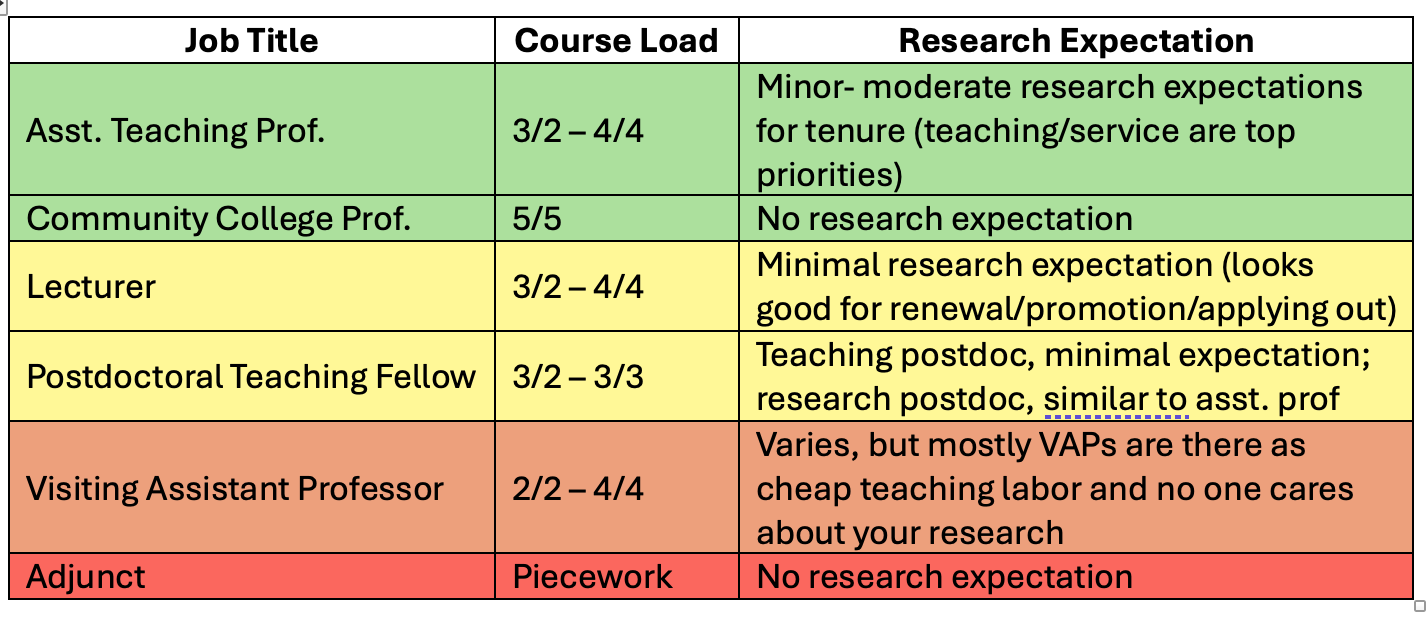
Caveats:
Myth: a TT job is the end-all and be-all of working in academia. Not every TT job is what we might imagine a TT job is or should be. A TT job at one institution could be worse than a lectureship, postdoc, or other “contingent” position at another institution. You should consider more than the job title when deciding what suits you and what is worth applying for.
Each job’s quality varies by institutional expectations, student population and demographics, university finances and resources, your prospective coworkers, and you personally. Even what looks great on paper may not be so great (or vice versa).
Academia runs on manufactured insecurity. Academics are conditioned to pursue TT jobs at all costs and often taught to settle for less. You do no need to—and perhaps even should not—settle for a TT job that doesn’t feel like a good move for you. You should consider what makes a job “worth it.” Have a list of needs and non-negotiables that can help you 1) filter out jobs that may be a waste time if applied for and 2) help you make decisions if/when you get job offers. (If you cannot live in, like, Texas, you don’t have to apply for jobs in Texas. If a job seems degrading or like it won’t allow you to have a life beyond academic, you have permission to not apply.
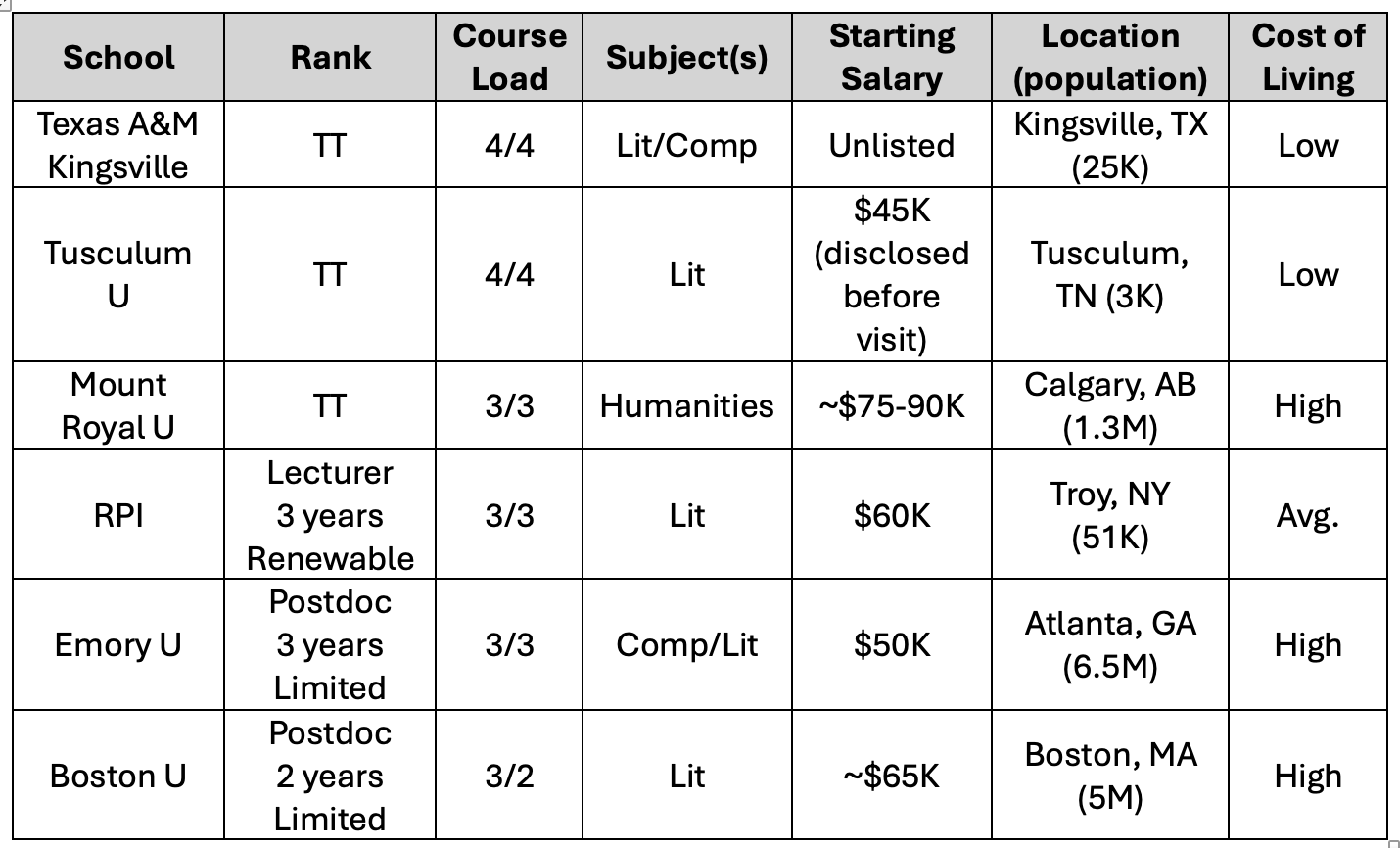
Sample jobs I was a finalist for/accepted:
PART II. HOW TO READ A TEACHING JOB AD
Academic job materials follow basic templates. But because of the conditioning problem mentioned above, many applicants write as though each job calls for the same template.
If you are seeking teaching-focused jobs, then you need teaching-focused templates, too.
Some departments/institutions’ job listings can help you decide when to bust out the teaching-focused templates.
Three categories of teaching-focused job listing (most → least ethical):
Most ethical: upfront about their needs and explicit about the fact that their institution’s faculty primarily teach. For example, Tusculum University:
“is a teaching-focused institution. We are looking first and foremost for excellent classroom teachers who genuinely enjoy teaching and are committed to student learning. We seek candidates who demonstrate strong teaching ability, value meaningful faculty-student interaction, and are committed to creating engaging learning experiences that support student success. These qualities align with Tusculum’s mission to provide an “active and experiential education.”
Somewhat ethical listings are usually the lectureships or postdocs, liminal jobs that genuinely want to encourage candidates’ research activity but butt up against the reality of hiring cheap, un-tenureable workers. Emory’s Writing Program Postdoc:
“We seek applicants with experience in teaching writing-intensive courses and who have further interest in teaching writing, pedagogical innovation, program development, and assessment. We are especially interested in applicants with experience in or preparation for teaching technical communication.”
This job is less committed to hiring candidates who are “first and foremost… excellent classroom teachers.” They will often note the need for an “active research agenda” but are mainly looking for teaching. They’re not trying to mislead you; they’re doing their best in a bad situation.
Other job ads “pose” as TT research jobs when they’re anything but. To me, these ads are the most disingenuous. If they are not TT, they present like TT jobs nonetheless, requiring impactful and active research. But then the teaching load is 3/3 – 4/4. That institution may expect research from you, but they are going to give you minimal–zero resources to do it.
Caveat: There are TT job ads that read like a category 3, but they will be forthcoming in interviews about the emphasis on teaching. (Texas A&M – Kingsville, for instance, only required a couple peer reviewed articles for tenure and had a 4/4 course load.)
Rule of thumb: if the teaching load is 3/2 or higher, use your teaching template. My view is, you will stand out among the other applicants relying on the classic TT position letter and be taken more seriously.
Can I still do research in a teaching job?: Yes, but also: being on the tenure track is not a guarantee that you will produce much research. Nor does being in a teaching position guarantee that you won’t. You should understand what capacity each position will afford you for research.
If not writing monographs and regularly publishing articles is a deal-breaker for you, then maybe don’t pursue jobs with a 3/2 course load or higher.
You may also want to really deliberate whether you want to continue doing research at all. Do you have other activities, hobbies, passions in your life that you want time for, and do they outweigh research and publishing?
We are at the point in academia where many renewable teaching jobs are better than TT jobs. Factor in everything that’s important to you and the life you want, and make decisions about which jobs are suitable/desirable.
PART VI. HOW TO WRITE A LETTER FOR A TEACHING JOB
Most academic cover letters for TT jobs follow this basic format:
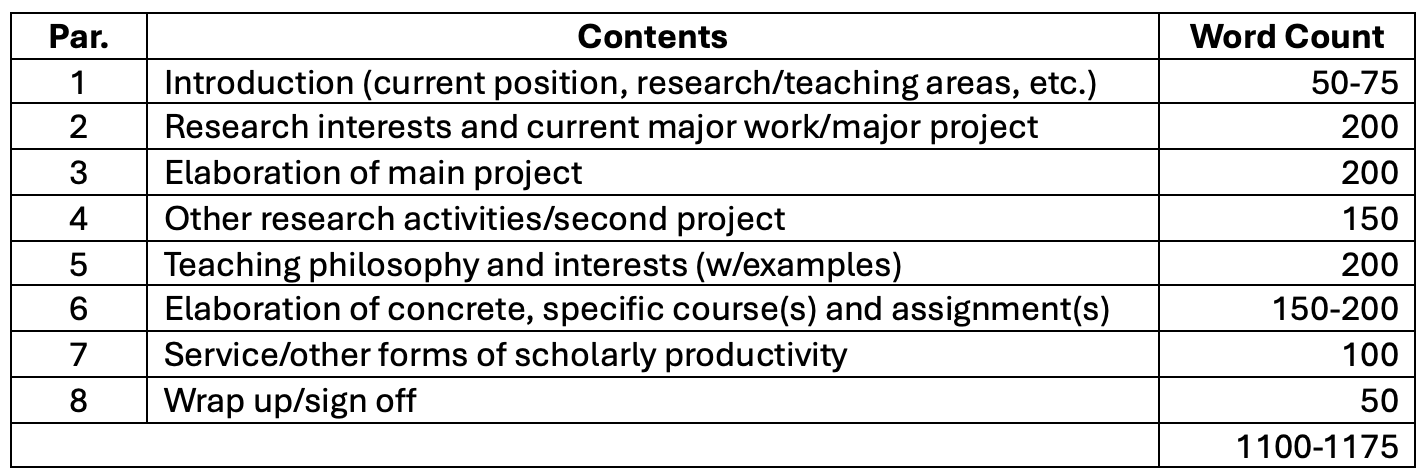
Rough organization for a research-focused position.
For teaching-intensive jobs, flip your central pars. and prioritize your teaching philosophy, examples of effective instruction, and connection between pedagogy and research:
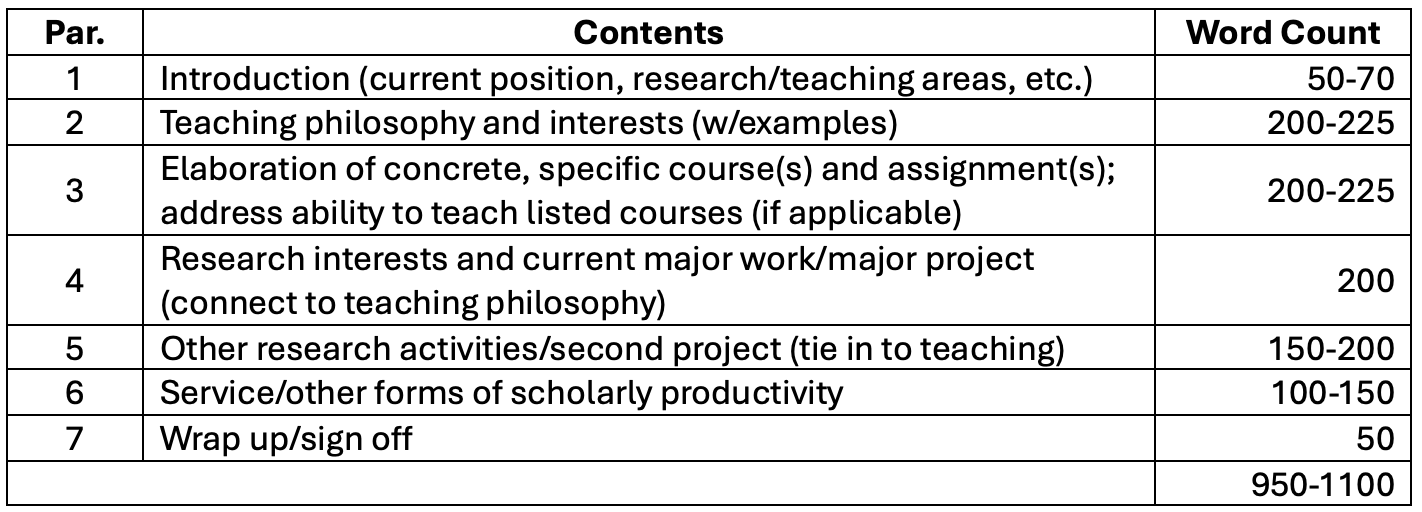
Rough organization for a teaching-focused position.
General advice for all letter types:
No more than 1,100 – 1,200 words max.
1-inch margins
Times New Roman, 11 – 12 pt. font (I like 11.5)
Simple, declarative sentences; complexity of thought, simplicity of language
Clear stakes/learning outcomes of your research/teaching
One or two punchy examples of something beats 3+ examples
In the worst letters I have read for teaching-focused positions the applicant:
Does not seem to understand they are applying for a teaching position and privileges research at the expense of their teaching
Has little teaching experience or does not clearly convey their experience
Is vague and does not identify specific courses, assignments, learning outcomes, or impacts
Has given no or minimal consideration for specific courses listed in the job ad
Is jargony and flexes their research, which can read as dismissive or disrespectful to teaching (and people on your search committee may be exclusively teaching faculty)
In the best letters I have read the applicant
Is clearly aware that this is a teaching position
Privileges teaching experience and ties research interests into their pedagogy and courses
Is specific and concrete, providing one-two exemplary courses plus a unique and impactful assignment or sequence of assignments and its specific learning outcomes
Connects their teaching to courses or curriculum in the job ad (if applicable)
Is clear about the stakes of their pedagogy and conveys their enthusiasm for teaching
Is still confident about the relevance of their research, but doesn’t try to overwhelm readers with it